Stop Guessing Environmental Loads — Start Designing from a Real Mission Profile
Most products don’t fail because engineers lack intelligence. They fail because the real-world duty cycle was never clearly defined.
Before running thermal, vibration, humidity, or salt tests, we should ask:
What will this product actually experience over its lifetime?
Duty cycle definition is especially important because specifications are typically written to be generic. They are designed to cover broad application ranges, not your specific product in your specific environment. When engineers apply specifications blindly, they either over test (adding cost and time) or under test (missing real failure mechanisms). A quantified mission profile allows designers and reliability engineers to apply specifications intelligently tailoring severity, duration, and acceleration to match actual lifetime exposure instead of assuming the worst or hoping for the best.
The Problem
In many programs, environmental testing becomes a checklist exercise. Tests are executed, reports are generated, and "pass" becomes the objective.
But without a quantified duty cycle:
- Stress levels are guessed
- Durations are arbitrary
- Acceleration lacks context
- Cumulative lifetime exposure is unclear
Design decisions deserve better inputs.
The Mission Profile Builder
I built a Mission Profile / Duty Cycle Builder inside Reliatools to make environmental assumptions explicit and measurable.
See the Tool
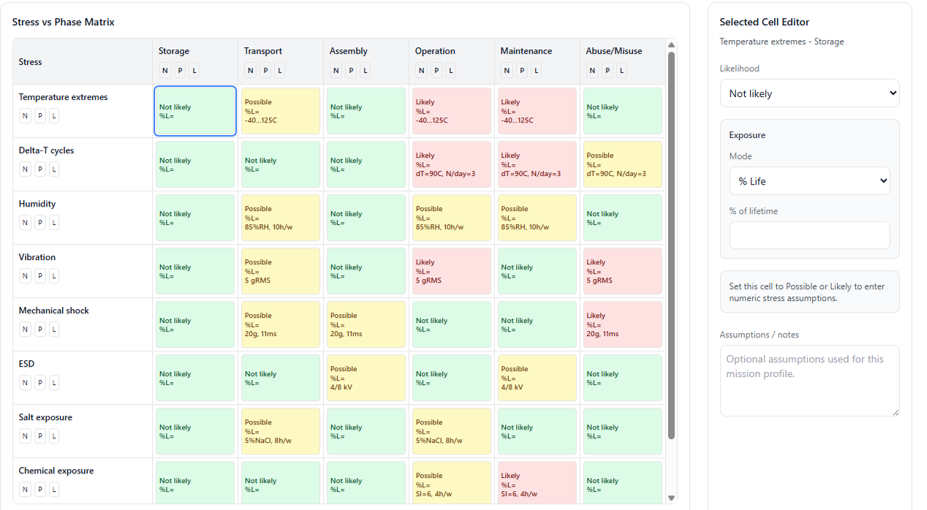
The screenshot above shows the full workflow in one view:
- A Stress vs Phase matrix on the left, where engineers click N / P / L (Not likely / Possible / Likely).
- Stress values displayed directly inside each cell (ΔT, RH, Grms, kV, etc.).
- Exposure clearly defined per phase (% of life, fixed hours, or once-per-life events).
- A Selected Cell Editor panel on the right to refine likelihood, exposure model, and numeric assumptions.
- Everything is tied to a defined target life (years or hours), allowing the tool to calculate total lifetime exposure and event counts.
The conversation shifts from:
"It might see high humidity."
To:
"Over 10 years, it will see ~1,200 hours above 95% RH and ~800 thermal cycles of ΔT ≈ 70°C." That’s a different level of engineering clarity.
Why It Matters
A structured mission profile connects:
Field reality → Physics of failure → Validation strategy → Robust design
It improves DFMEA inputs, supports rational derating, and grounds accelerated testing in actual lifetime exposure.
Try It
Try it directly in the Mission Profile Builder.
Ready to quantify your real environmental loads?
Build a defensible duty cycle and map lifetime exposure before writing your next test plan.
Try the Mission Profile Builder