Taguchi + Bayesian Test Planning: From Static DoE to Adaptive Reliability Learning
In traditional reliability validation, we often rely on static Design of Experiments (DoE) to explore design factors materials, geometry, cooling methods, or operating conditions and see how they affect failure modes such as insulation aging or bearing wear.
But as products become more complex and test budgets shrink, the question isn’t “how do I test everything?” it’s “how do I learn the most from the fewest tests?” That’s where the fusion of Taguchi methods and Bayesian modeling comes in.
Taguchi gives robust design and efficient screening. Bayesian inference gives adaptive learning and prediction. Together, they can turn reliability testing into a data driven decision engine.
Adaptive loop
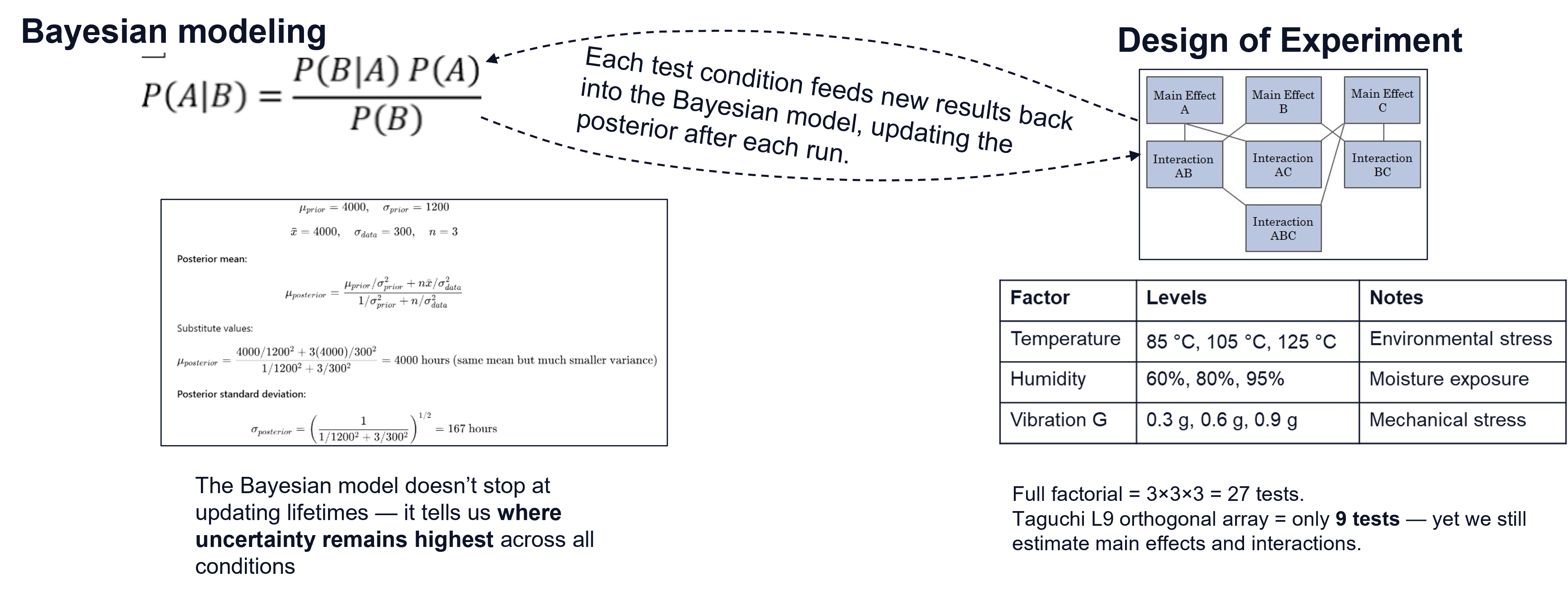
The key idea is to turn validation into an adaptive learning loop: Test → Update → Decide → Next Test.
The problem with traditional test planning
Most validation plans today still follow fixed sequences:
- 9–16 Taguchi runs per factor combination
- Static durations and sample sizes
- Pass/fail logic without quantified uncertainty
This approach works, but it’s wasteful. It doesn’t tell you how confident you should be in your results, nor does it adapt when early tests already show a clear trend.
What if instead of running 50 samples, you could stop after 20, knowing with 90% confidence your design meets the reliability target?
Taguchi: the foundation of robust design (induction motor example)
Taguchi methods simplify experimentation by arranging factors and levels into orthogonal arrays, allowing engineers to explore multiple variables with minimal tests.
Example: induction motor design choices
| Factor | Levels |
|---|---|
| A: Insulation class | B (130°C), F (155°C), H (180°C) |
| B: Bearing strategy | Standard, High-temp grease, Sealed-for-life |
| C: Cooling method | TEFC, TENV, TEWC (water jacket) |
| D: Drive type | Line-start, VFD (no filter), VFD + dV/dt filter |
Evaluating all combinations would require 81 tests. Using a Taguchi L9 array, we can screen the design space with just 9 experimental conditions.
Signal-to-noise ratio (S/N)
The output metric is typically a Signal-to-Noise ratio, where “noise” represents variations in ambient temperature and load.
Here, might be winding temperature rise or vibration amplitude. The configuration with the highest S/N is the most robust — meaning it performs consistently even when conditions vary.
Where Taguchi falls short
Taguchi alone often assumes:
- All test outcomes are equally weighted
- Factor interactions are limited
- Noise factors are static
- Confidence is qualitative, not probabilistic
In real systems like motors, degradation is uncertain and multi-physics-driven. We need a way to update knowledge continuously as data accumulates — that’s where Bayesian modeling transforms the process.
Enter Bayesian reliability modeling
Bayesian modeling allows us to combine prior knowledge (legacy motor data, standards, expert judgment) with new experimental results to continuously refine reliability predictions. The foundation is Bayes’ rule:
- : prior belief about life model parameters (e.g., insulation activation energy)
- : likelihood from test data
- : posterior belief after testing
- Predict lifetime distributions under real operating conditions
- Quantify confidence in meeting reliability targets
- Decide whether additional tests are worth running
Combining Taguchi and Bayesian: the hybrid approach
- Phase A — Robust Screening (Taguchi): Use inner (control) and outer (noise) arrays to identify robust motor configurations under ambient and load variation.
- Phase B — Bayesian Confirmation: Fit Bayesian degradation and life models linking stressors (temperature, vibration) to failure mechanisms such as insulation aging or bearing wear.
- Phase C — Adaptive Decision: Use Bayesian inference to decide when to stop testing.
If confidence is high, testing stops early. If not, the model identifies which next test adds the most information.
Real-world case study: induction motor validation
Scenario
- A plant selects a 7.5 kW (10 HP) induction motor for a continuous-duty conveyor.
- Mission / target: 5 years (~43,800 h) with reliability target .
- Key stressors: ambient heat, load variation, vibration/misalignment, VFD power quality.
- Dominant PoF: stator insulation aging (thermal oxidation) and bearing wear / lubrication breakdown (vibration + temperature).
Step 1 — Taguchi screening (smart testing)
Using a Taguchi L9 design (9 configurations × 3 replicates), the team evaluates motor options under ambient (25°C vs 45°C) and load (60% vs 100%) noise.
| Design | ΔT mean (°C) | S/N (dB) |
|---|---|---|
| Class B, TEFC, Line-start | 82 | −38.3 |
| Class F, TEFC, VFD | 58 | −35.3 |
| Class H, TEWC, VFD + filter | 34 | −30.6 |
Class H + TEWC + VFD filter is the most robust configuration in this screening set.
Step 2 — Bayesian confirmation (learning as you go)
For insulation aging, the team applies an Arrhenius thermal acceleration model:
Priors: (activation energy), Weibull shape . Accelerated test: 180°C endurance; first failures at 820, 910, 1040 h. Bayesian updating converts these failures into a posterior life distribution at use temperature.
Step 3 — Adaptive planning (in-situ Bayesian updating)
After three failures, the Bayesian model highlights where uncertainty remains highest:
| Planned test | Risk | Posterior confidence |
|---|---|---|
| Power quality (VFD harmonics) | Low | 0.92 |
| Hot ambient margin | Medium | 0.88 |
| High vibration / misalignment | High | 0.59 |
The team skips extended power-quality testing and focuses on vibration testing, where uncertainty is highest.
Worked calculations (samples)
(A) Taguchi S/N for winding ΔT
Replicates: 33, 34, 35 °C
(B) Arrhenius acceleration
, ,
(C) Vibration influence power law (illustrative)
Step 4 — Lessons learned
| Insight | Impact |
|---|---|
| Taguchi reduced the design space early | Faster convergence |
| Bayesian models quantified uncertainty | Objective decisions |
| In-situ updates redirected testing | Fewer wasted tests |
Why it matters
| Benefit | Impact |
|---|---|
| Fewer tests | Stop when confidence is reached |
| Smarter sequencing | Focus on high-uncertainty risks |
| Quantified confidence | Explicit probability of success |
Taguchi helps you test smart. Bayesian modeling helps you learn smart. Together, reliability testing adapts as data comes in — saving time, cost, and risk.
Reliatools links
Use the Arrhenius Calculator to translate accelerated thermal tests to field life. For early failure screening and equivalent life planning, try the Burn-In Wizard.
Conclusion
The Taguchi–Bayesian hybrid shifts reliability engineering from static validation to adaptive learning. This approach is especially powerful for complex systems like induction motors, where multiple physics interact and uncertainty matters.
Explore more tools on Reliatools.